DecisionManager

Platform/Decision Server

Runtime

Deploy and execute on the hot path

Decision Server is the hot path — where rule versions authored in Decision Manager are deployed, exercised in the API workbench or probe, executed against live traffic, and measured.

Get started

Decision Server

Runtime & observability

The hot path: deploy, execute, and measure decisions in production.

Built for
Platform and SRE teams
  • Deployment matrix across environments
  • API workbench, probe console, idempotent batch
  • Decision warehouse browser & writer health
Open the console

Capabilities

What it does

Real operator surfaces: API workbench, probe, deploy matrix, warehouse — deploy, execute, measure without owning the policy text.

  • Deploy

    A deployment matrix across environments, with sub-second hot-deploy, blue/green slots and sticky A/B — no application redeploy to change a rule.

  • Execute

    Compiled multi-key indexes on a Rust service over PostgreSQL. Operators use the API workbench (collections, environments, assertions, multi-language snippets — decision-native) and the probe console; production traffic uses the same execute path.

  • Measure

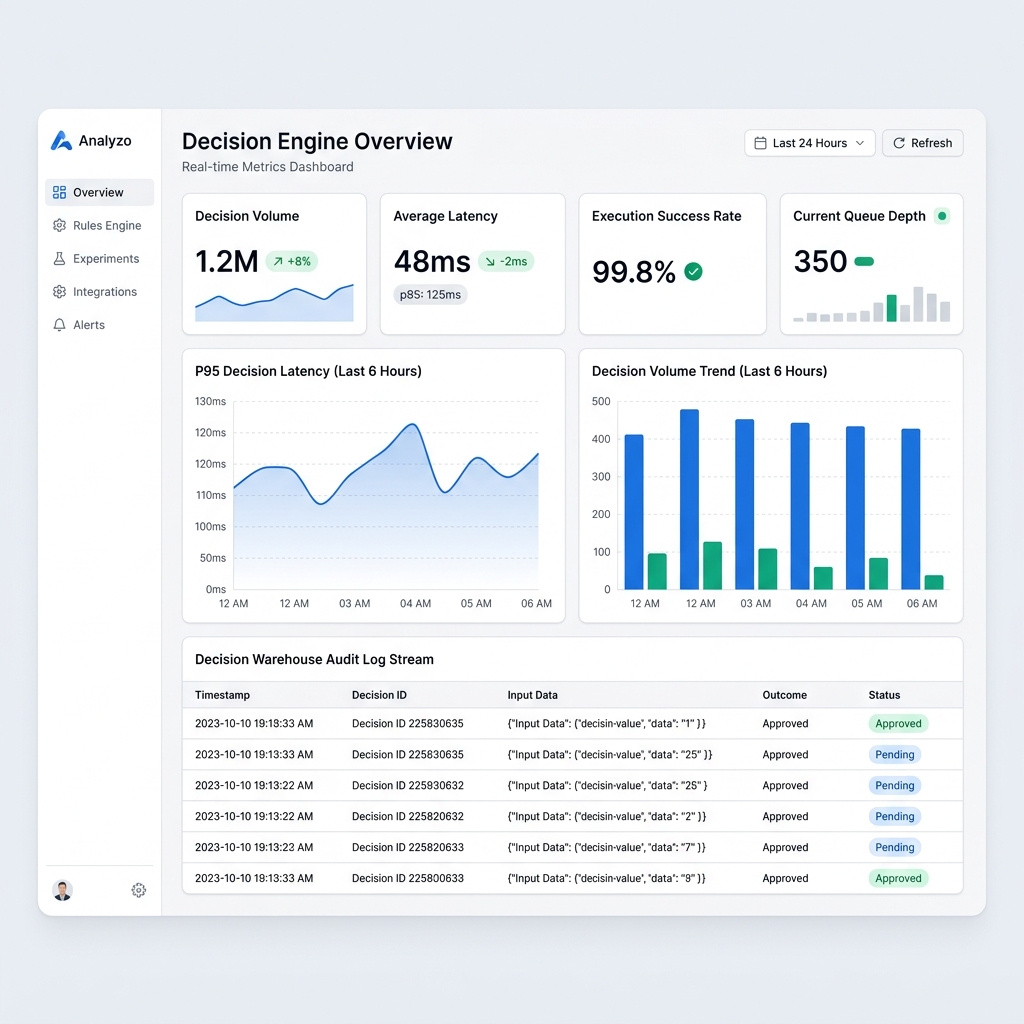
    Execution KPIs, the decision warehouse browser, and writer health — so a decision can be explained after the fact. Published latency: ~3.4 ms end-to-end for a 2 MB request against 500 candidates (including parse).

At a glance

  • API workbench — collections, environments, assertions, code snippets
  • Probe console and idempotent batch execute
  • Blue/green slots and sticky A/B without app redeploy
  • Decision warehouse for post-hoc explanation
  • Published ~3.4 ms (2 MB / 500 candidates) — method stated, not a marketing floor

Decision engine · XU honesty

LiveShipped and available in product today

Single-pass Rust engine — not a Rete product

Decision Server runs a compiled single-pass engine with multi-key equality indexes, residual_rules, hit policies, and a hard step budget. We name residuals so leads never confuse Live product with classic ODM XU marketing.

LiveShipped and available in product today

What is Live on the hot path

  • Single-pass evaluation with multi-key equality indexes
  • Hit policies: FIRST, PRIORITY, RULE_ORDER, ANY, ALL, COLLECT, UNIQUE
  • Step budget + optional wall clock; admission pool / SERVICE_BUSY shed
  • Deploy cache, hot prewarm/swap, batch execute, engine.steps on every response
ResidualNot productized yet — stated for honesty, not marketed as ready

Named residual — never claimed Live

These classic ODM/XU surfaces are residual. DecisionManager does not ship them as product:

  • RetePlus / Working Memory / Agenda multi-algo inference
  • Sequential / Fastpath algorithm picker as a product control
  • JCA resource adapter / XU connection-pool product UI

Performance & high availability

LiveShipped and available in product today

Measured latency, hot deploy, and process resilience

Figures come from the product binaries under documented conditions — not customer averages or freestanding sub-2 ms floors.

~3.4 ms

End-to-end execute

2 MB request · 500 candidates · includes parse

Sub-second

Hot-deploy path

Blue/green slots & sticky A/B · no app redeploy

~20 ms

Cold start (edge)

Debug build · Postgres stopped · method stated

  • Step budget & residual_rules

    Every decision stays inside a deterministic step budget; residual_rules keep non-indexed paths honest and measurable.

  • Admission & deploy cache

    Process admission and L1 deploy cache protect the hot path under load; cache invalidation follows version publish.

  • Hot deploy & canary

    Hot prewarm/swap and canary/blue-green without restarting the application that calls execute.

  • Batch & backpressure

    Idempotent batch execute and SERVICE_BUSY shed when capacity is exhausted — Live signals, not invented autoscalers.

Residual (not Live): multi-algo Rete/GPU/JIT product, multi-region active-active mesh, closed-loop auto-rollback. Named so enterprise buyers can plan honestly.

Observability

LiveShipped and available in product today

Decision warehouse and execution KPIs

See what fired, how long it took (engine.steps on every response), and writer health — so a production decision is explainable after the fact. We publish ~3.4 ms (2 MB / 500 candidates), not a freestanding sub-2 ms average.

Warehouse matched[] traces, topology health, SLO burn, and rule telemetry — explain a production decision after the fact without inventing multi-XU JMX maps.

Decision Server runtime telemetry and decision warehouse

API workbench

LiveShipped and available in product today

decision-API execute workbench on the same path as production

Operators exercise collections, environments, assertions and multi-language snippets against the real execute API — plus probe and idempotent batch — without a separate mock server.

  • Collections, environments and assertions on the live execute path
  • Multi-language code snippets for client integration
  • Probe console for single-decision diagnosis
  • Idempotent batch execute for bulk validation

Workbench is included with Decision Server on every plan — same runtime production traffic uses.

Go deeper

Engine, performance, observability, cloud

Dedicated feature pages for the capabilities that usually decide a BRMS shortlist — with Live / Residual honesty carried through.

  • LiveShipped and available in product today

    Decision engine

    Single-pass indexes, hit policies, residual_rules — and residual Rete/JCA named plainly.

    Open feature page
  • LiveShipped and available in product today

    Observability

    Warehouse, telemetry, topology, SLO burn — post-hoc explanation without invented badges.

    Open feature page
  • LiveShipped and available in product today

    Cloud, edge & ops

    Containers, K8s, hash-verified edge bundles — account-scoped edge, not a global multi-region mesh we don't operate.

    Open feature page

Audience

Who uses it

Platform and SRE teams: the people who own uptime, latency and rollback. Rule authors do not need it to change a rule — that happens in Decision Manager and arrives here as a published version.

Migration

What it replaces in an IBM ODM estate

It replaces the ODM execution tier: RuleApp deployment cycles onto a Java EE rule execution server running on WebSphere Liberty or Tomcat, where a bad version is reverted by redeploying the previous RuleApp and restarts carry risk. Decision Server is a stateless container over one PostgreSQL database, with no provider-specific code.

The latency and architecture comparison used above is the same one on the home page battlecard; the execution API is documented without an account.

Get started

Try the runtime, or book an executive walkthrough

Self-serve trial includes Decision Server and the API workbench — no card, no auto-convert. Prefer a seller who can map ODM XU residual to your estate? Book a meeting.

No credit card · Trial does not auto-convert · Residual Rete / JCA stated on this page