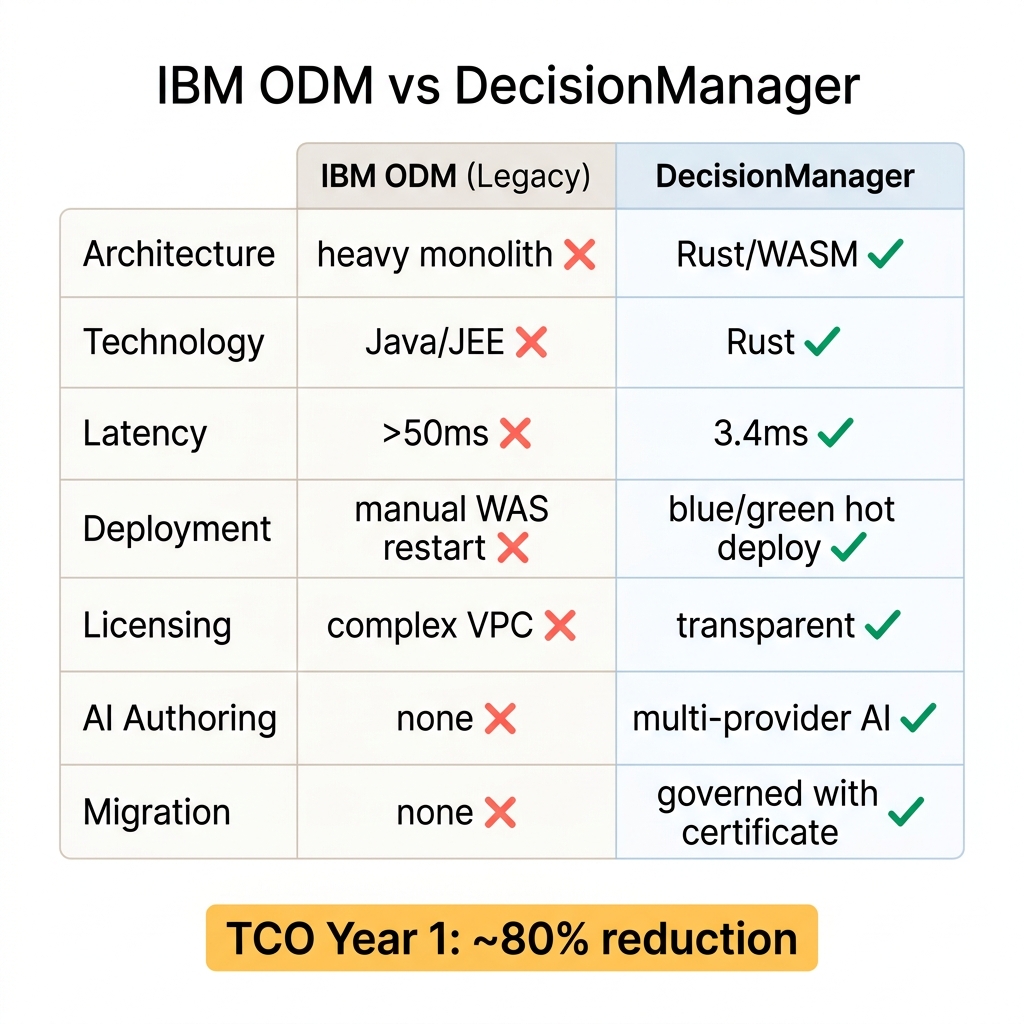
For teams evaluating a move off IBM Operational Decision Manager. Below is the capability table, the measurements behind the rows that carry the most weight, the commercial comparison, and — stated rather than hidden — the places IBM ODM is genuinely ahead.
Step budget, wasm/edge packaging, decision warehouse, and a free trial that is not empty — shipped capabilities, not a roadmap slide.
Deterministic step budget
Same input reaches the same verdict under load and on regulatory replay — bounded by steps, not a wall-clock timer.
Live
Wasm & edge bundles
Verified wasm32 engine and hash-verified edge bundles — Lambda, Workers, Cloud Run, or no-database edge under your account.
Live
Decision warehouse
Post-hoc explanation, execution history, and KPI streams so operators prove what ran after the fact.
Live
Free trial, seeded
Signup creates a project, decision service, ruleset, published version and active dev deployment in one transaction — no empty shell.
Live
Where IBM ODM still leads
Mature BAL for non-technical authors, DVS scenario ecosystem, installed-base connectors, and formal certifications. We follow SOC 2-aligned practices but hold no certification today — and we do not claim one-click automated ODM migration.
Competitive Battlecard
IBM ODM vs DecisionManager
Structural differences against IBM Operational Decision Manager — numbers match the measured figures elsewhere on this site, and the places ODM still leads are stated on the comparison page below.
IBM ODM vs DecisionManager
Capability
IBM ODM
DecisionManager
Runtime Architecture
Java EE Decision Server on WebSphere Liberty or Tomcat, plus a repository database and the XU connector
Native Rust services (platform, manager, runtime, admin) over PostgreSQL — or a 947-byte edge bundle with no database
Decision Latency
Wall-clock timer (ruleset.decisionEngine.maxRunningTime); XOM binding cost grows with payload size
~3.4 ms for a 2 MB request against 500 candidates (compiled multi-key index); deterministic step budget, not a timer
Deployment Model
Redeploy a RuleApp version from Decision Center to Decision Server to roll back
Blue/green slots per service with active-slot switch and rollback_to — no cache flush, no full redeploy
Developer Experience
Eclipse Rule Designer (release-pinned Eclipse + Java): mature BAL/BOM tooling and a step-through ruleflow debugger — the strongest day-to-day debug experience in this category
VS Code extension (.vsix, not Marketplace yet) + browser Manager/Server consoles: vocabulary-driven LSP against the live server, real Git export, governed deploy. No step-through debugger yet — the decision trace is post-hoc, not mid-execution
Licensing Model
Per-core / per-server entitlements; authoring, runtime and consoles licensed separately
One commercial relationship: authoring, runtime and all three consoles included (quote-based plans)
Governance & Audit
Decision Center lifecycle with repository-backed version identifiers
Draft → review → approved → published with separation of duties and a content-hash provenance trail
Start free, or talk to an executive seller
Self-serve trial with a seeded workspace — or book a demo on your underwriting, claims, or eligibility policy. Both paths stay open on every major page.
No credit card · Trial does not auto-convert · Export anytime
The migration engine maps BRL, ruleflows, decision tables and BOM verbalizations; every artifact still needs human review before publish. Run a free assessment on your export — nothing is uploaded.
vs. IBM ODM
Where we are structurally different — and where ODM still leads
A rules platform is bought against IBM Operational Decision Manager, so compare it against ODM properly. Below is what is architecturally different, followed by the four places ODM is genuinely ahead. If a vendor's comparison page has no second list, it is a brochure.
Capability by capability
Every row states what each product actually does, not a checkmark. Sourced from the vendor's own documentation on the ODM side.
Capability by capability
Every row states what each product actually does, not a checkmark. Sourced from the vendor's own documentation on the ODM side.
Capability by capability
Capability
DecisionManager
IBM ODM
Bound on a runaway decision
Deterministic step budget — the same input always reaches the same verdict, including the same refusal
ruleset.decisionEngine.maxRunningTime — a wall-clock timer, because a rule action is arbitrary Java through the XOM
Cost of a decision, reported
engine.steps on every execute response; live saturation on GET /api/health/engine
Execution time in the Decision Warehouse; no deterministic per-decision cost unit
Large payloads under load
A 2 MB request matched against 500 candidates returns in ~3.4 ms — the payload is parsed once and evaluated through a compiled multi-key index, not re-walked per rule
Request data is bound into the XOM as Java objects before the network runs; IBM's own tuning guidance treats payload size and XOM binding as a primary cost
Smallest deployable unit
947-byte hash-verified bundle plus a 1.5 MB WebAssembly or native engine — no database, no pool, no outbound network
Decision Server Runtime: a Java EE application on WebSphere Liberty or Tomcat, plus a repository database and the XU connector
Serverless and edge targets
Lambda, Cloudflare Workers, Cloud Run and in-process embedding via a verified wasm32 build
None — Decision Server cannot be deployed as a function
Cold start to first decision
~20 ms measured on the edge binary, debug build, with Postgres stopped
JVM start plus first-invocation ruleset parsing, which the vendor's own documentation flags as processor- and memory-intensive
Rolling a bad decision back
Two slots per service, each with its own head. Switching the active slot moves live traffic, and rollback_to returns it — no redeploy, no cache flush, and the response reports which slot answered
Revert by redeploying the previous RuleApp version from Decision Center to the Decision Server
Blast radius of one heavy decision
Isolated execution pool, contained panics, retryable SERVICE_BUSY under saturation — health checks stay answerable
Executes inside the XU in the application server's thread pool
Proving which logic ran
sha256 content hash over the canonical definition, carried in the bundle and returned on every edge decision
RuleApp and ruleset version identifiers from the repository
AI-assisted authoring
Anthropic, OpenAI, Gemini, Bedrock-compatible and self-hosted, with ordered provider fallback and a content-hash cache; output is always reviewed, never auto-persisted
Separate IBM offering; not part of the ODM classic authoring path
Console languages
English, French, Spanish and Arabic with full right-to-left layout in all three consoles
Broad language coverage; right-to-left support is not part of the console contract
How you are charged
One subscription. Authoring, runtime and all three consoles included
Per-core and per-server entitlements, with authoring, runtime and consoles licensed separately
Start free, or talk to an executive seller
Self-serve trial with a seeded workspace — or book a demo on your underwriting, claims, or eligibility policy. Both paths stay open on every major page.
No credit card · Trial does not auto-convert · Export anytime
Run free migration assessment — Point at an IBM ODM export in the browser for an inventory of action rules, decision tables and ruleflows. Nothing is uploaded.
The measurements behind those rows
Reproducible
~3.4 ms
2 MB request, 500 candidates
End-to-end execute, including parsing the payload. The candidate set is matched through a compiled multi-key index, so cost grows with the data, not with the rule count.
947 B
Signed decision bundle
The whole deployable unit. It carries its own sha256 content hash and serves decisions with no database, no connection pool and no outbound network.
~20 ms
Cold start to first decision
Measured against a definition taken from a running database — with Postgres then stopped. Nothing is fetched at request time.
1.5 MB
WebAssembly engine build
A verified wasm32 build over a six-crate dependency set. The same engine runs in Lambda, Cloudflare Workers, Cloud Run, or in-process.
Figures are taken from the release build of the engine and the edge binary on commodity hardware, not from a tuned lab. Cold start is measured on a debug build, so a release build is the floor rather than the ceiling. We publish the conditions because a number without its method is a claim, not evidence.
Legacy ODM suites
Enterprise contracts
licenses + infrastructure + consultants
Complex multi-year license agreements
Per-core and per-server licensing models
Authoring, runtime and consoles licensed separately
Consultants required for every change cycle
Months-long deployment projects
DecisionManager
Quote-based plans
all three consoles included
One commercial relationship — authoring, runtime and consoles together
Multi-provider AI authoring built in, not bolted on
IDE workflow: Git-friendly projects, dm CLI
Self-serve changes by your own team
Deploy in days — cloud, your cloud, or on-prem
Simpler
path to production vs classic ODM estates*
*Architectural comparison only. Commercial terms are quote-based; start a free trial or talk to sales. Actual outcomes vary by vendor and scope.
Start free, or talk to an executive seller
Self-serve trial with a seeded workspace — or book a demo on your underwriting, claims, or eligibility policy. Both paths stay open on every major page.
No credit card · Trial does not auto-convert · Export anytime
Full ODM purpose — Live, Partial, and named Residual
IBM ODM's BRMS purpose is to separate decision logic from application code so business-owned Decision Services stay governable, testable, and deployable. Below is how DecisionManager maps that purpose today — with product-truth badges, not marketing greenwash.
Live means real Manager / Decision Server APIs. Partial means shipped core with documented depth limits. Residual means classic ODM products we name for migration planning — never a fake Live toggle for RetePlus, Java XOM JAR, or SOAP HTDS.
These are the ODM-class purpose goals DecisionManager ships today on the same paths production execute uses.
Live
Separate decision logic from apps
Versioned Decision Services and HTDS-style HTTP apps keep rule logic out of application code — the core ODM BRMS purpose.
Live
Business concepts / BOM vocabulary
JSON vocabulary is the Live object model: classes, domains, categories, and vocabularyRef binding for authoring and execute.
Live
Business-owned rules & decision tables
Action rules, decision tables, and hit policies (FIRST, PRIORITY, RULE_ORDER, ANY, ALL, COLLECT, UNIQUE) on the Live engine path.
Live
Verbalization / BAL-style phrases
Verbalization and phrase-oriented authoring so business authors can read and review logic without inventing a second object model.
Live
Multi-stage ruleflow orchestration
Entry guards, tasks, and gateways execute on the Live path. Fine-grained fork/join depth is Partial — see below.
Live
Decision trees (flatten-to-FIRST)
Live: kind decisionTree, ordered TreeEditor outline, path count, POST /trees/flatten + /trees/analyze, one-click convert to a FIRST decision table. Runtime executes only the flattened FIRST table — never a freeform tree engine.
Live
Governable lifecycle (DGF-class)
Releases, change activities, approvals / SoD, and audit trails map Owner / Author / Approver / Tester ranks to Live governance.
Live
Test suites & scenarios
Expected-vs-actual suites, scenario templates, promote paths, and CLI copy for regression before deploy.
Live
Decision Warehouse / matched[] traces
Post-hoc fire order and matched[] warehouse traces for regulators and operators — Live explain path, not mid-execution Rete Agenda.
Live
Deploy configs · hot · canary
Deployment configurations, environments, hot-deploy, and canary / blue-green traffic without rewriting callers.
Live
HTDS-style REST execute + OpenAPI
Apps execute, OpenAPI, and the API workbench on the same Decision Server path as production traffic.
Live
VS Code / Studio authoring
Desktop extension and Manager consoles for authoring, deploy, and trace — Live alternative to Eclipse Rule Designer residual.
Live
ODM migration inventory path
Browser-side ODM export assessment and Manager import gap report — AI-assisted translation with human review, never one-click silent rewrite.
Partial
Partial — useful today, depth limits stated
Shipped capabilities with honest ODM-class gaps so migration teams do not over-assume full classic surface area.
Partial
Ruleflow task control depth
Multi-stage ruleflow is Live; fork/join, subflow/loop, exitWhen, and onError depth remain Partial vs full ODM task-control product.
Partial
Simulations / KPI product depth
Live batch dry-run and suites adjacent; full ODM-class simulation KPI workspace stays Partial / residual-adjacent — not marketed as complete DVS clone.
Partial
RuleApp / managed packaging
Signed .dmb bundles and export paths are Live; classic Ant ruleapp / full managed packaging product depth is Partial.
Partial
Browser tree-flatten mirror
When manager POST /trees/flatten is offline, the editor uses a labeled browser flatten mirror (Partial). Engine analysis is absent until the route answers. Live engine flatten stays Live; freeform ODM canvas stays Residual.
Partial
Progressive rollout zero-drop
Hot / canary / blue-green are Live. Zero-drop under every failure mode and closed-loop auto-rollback remain Partial / Residual.
Residual
Residual — named, never fake-enabled as Live
Classic ODM products DecisionManager does not clone as Live. Named so architects can plan ports without hype.
Never map RetePlus, Working Memory, Agenda re-activation, Sequential/Fastpath multi-algo, Java XOM JAR, JCA XU, or SOAP HTDS to Live. DecisionManager is a single-pass decision runtime.
Residual
RetePlus · Working Memory · Agenda
No RetePlus network, no Working Memory assert/retract product, no Agenda re-activation loop. Live fire order is post-hoc matched[] — not mid-execution Rete.
Residual
Sequential / Fastpath multi-algo picker
No selectable multi-algo XU mode product. One compile-once single-pass engine with equality indexes and residual_rules metering.
Residual
Java XOM JAR / B2X
No Java classpath XOM or B2X product. Live object model is JSON vocabulary / BOM — residual honesty for JAR-based estates.
Residual
JCA XU resource adapter
No JCA connection-pool XU product UI. Live adjacent: admission, SERVICE_BUSY shed, step budget, deploy cache.
Residual
SOAP HTDS
Transparent Decision Service SOAP/WSDL remains Residual. Live path is REST JSON apps execute + OpenAPI.
Residual
Eclipse Rule Designer full product
No Eclipse OSGi Rule Designer clone. Live desktop is VS Code extension / Studio with residual honesty panels where ODM still leads.
Residual
Freeform ODM decision-tree canvas
No invent freeform node-link tree diagram, reverse table→tree synthesizer, or separate tree evaluator. Live surface is the ordered branch outline plus engine flatten-to-FIRST.
Exercise Live purpose — or walk residual with an executive
Self-serve trial seeds a workspace with Manager, Server, and sample Decision Services. Prefer a seller who maps your ODM residual (Rete, XOM JAR, SOAP) honestly? Book an executive demo.
No credit card · Trial does not auto-convert · Residual Rete / XOM / SOAP never claimed as Live
Self-serve trial with a seeded workspace — or book a demo on your underwriting, claims, or eligibility policy. Both paths stay open on every major page.
No credit card · Trial does not auto-convert · Export anytime