Enterprise BRMS for regulated decisions
Credit, claims, and eligibility — decided the same way every time.
The decision automation platform banks, insurers, and healthcare teams use to author, govern, and execute policy — underwriting, claims, formulary and eligibility — without redeploying code. Every decision is bounded by a deterministic step budget, so the same input reaches the same verdict under load and when a regulator replays it years later.
Built for decision teams in
- Deterministic step budget
- Edge .dmb bundles
- Decision warehouse traces
- AI authoring · human review
- ODM migration assessment
- Seeded trial workspace
No credit card · Does not auto-convert · Seeded workspace ready in minutes
Or run the live demo — no signup required
- No credit card to start
- Does not auto-convert to a paid plan
- Book an executive demo via contact
- EU data residency on hosted plans
- hash-verified decision bundle
- 947 B
- cold start to first decision
- ~20 ms
- WebAssembly engine build
- 1.5 MB
- 2 MB request, 500 candidates
- ~3.4 ms
Measured end to end on the edge binary against a definition taken from a running database — with Postgres stopped. Throughput is a full execute including parsing the request. Cold start from a debug build, so a release build is the floor. Not customer-reported averages.
Industries
Where regulated decisions cannot drift
Underwriting, claims, formulary and eligibility change faster than release trains. DecisionManager keeps policy in governed tables — not buried in application code.
Banks & credit
Loan origination, DTI checks and credit policy on a deterministic step budget — the same verdict in production and on regulatory replay.
Banking use caseInsurers
FNOL triage, adjudication ruleflows and rating tables with warehouse matched[] traces and content-hash provenance for every claim path.
Insurance use casePharmacy & retail
Formulary checks, prior authorization, benefit caps and retail eligibility with workspace isolation — designed for teams that cannot invent certifications.
Pharmacy & retail use case
Migration proof
Two real ODM rulebases, imported and executing — including what did not translate.
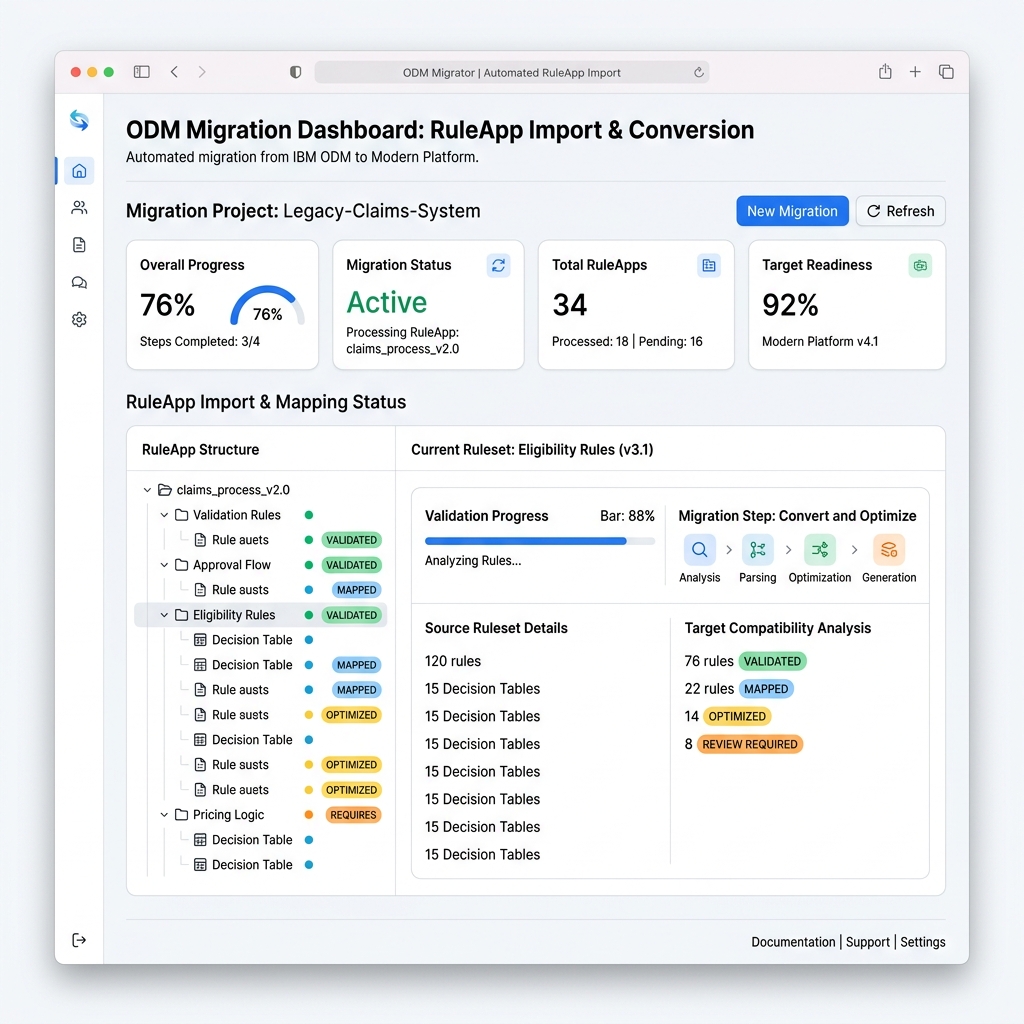
These are not estimates. Each number below is asserted by a test that runs in CI against a ODM export, and the two caveats are reported by the translator itself, not discovered later in production.
- BRL rules
- 26 / 26
- Sample refund rulebase — all translated
- Ruleflow leaves
- 12
- One node, structure preserved
- Reported caveats
- 2
- Flagged before commit, not after
- Import to first decision
- minutes
- Upload, analyse, commit, execute
| ODM construct | Result | Detail |
|---|---|---|
| .brl action rules | Mapped | All 26 rules of the Sample refund rulebase translate to platform rules with conditions and actions intact. |
| Ruleflow | Mapped | Task structure and ordering are preserved; the largest node keeps all 12 leaves. |
| Decision tables | Mapped | Rows, conditions and actions carry across; row identity is retained so a gap can name the row that moved. |
| BOM / B2X | Mapped | Object model and its virtual-to-execution bindings are read and used to resolve terms. |
| Templated messages | Caveat | A message body built with an ODM function such as Max(850000, 'High Balance Limit') is imported as a template placeholder and flagged for a human to confirm. Three such caveats in the eligibility rulebase. |
| Unresolvable vocabulary | Caveat | A term with no match in the exported BOM is reported as "not resolvable against the vocabulary" rather than guessed. A silently wrong output field in a regulated rulebase is worse than a reported gap. |
A realistic migration spine — not a contractual SLA
Days are indicative for a scoped pilot ruleset with human review. Multi-service estates take longer; we will not invent a calendar for yours.
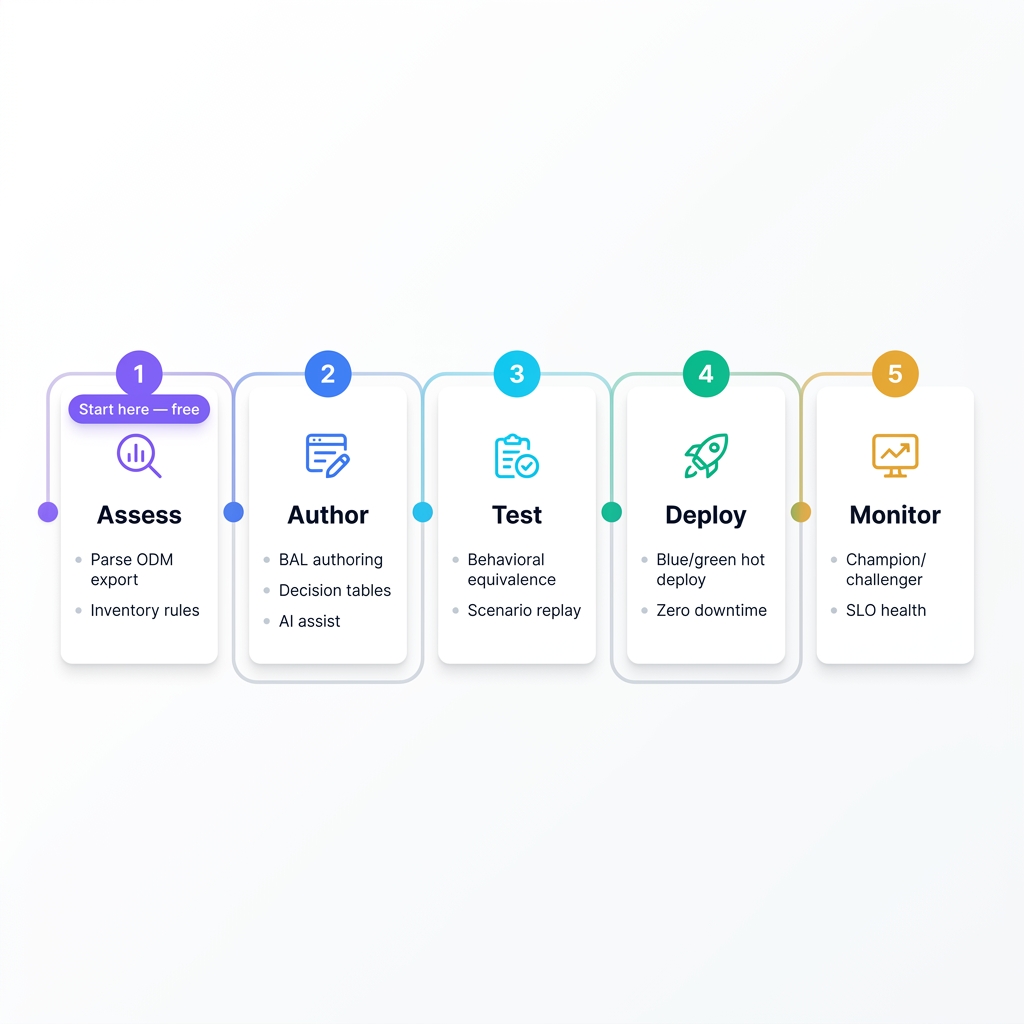
- 1Day 0
Private inventory
Browser scan of your export — size the estate without uploading.
- 2Days 1–3
Analyse & map
Trial workspace: translator + gap report; caveats named before commit.
- 3Days 4–10
Human review
Policy owners confirm templates, vocabulary, and exception paths.
- 4Days 11+
Publish & execute
Governed lifecycle, deploy to an environment, warehouse evidence.
Source: backend/crates/odm — sample_refund tests and eligibility fixture tests. The counts above are the assertions those tests make.
Frequently Asked Questions
Everything You Need to Know
Got questions about migration, compliance, performance, or deployment? We've got answers.